
The runway in 2026 felt less like a test track and more like a circus ring built for horsepower, ego, and very expensive tires. Matt Watson stood at the center of the chaos, grinning like a man who had just handed four absurdly powerful performance SUVs to drivers with something to prove. The lineup was pure theatre: a Porsche Cayenne Turbo E-Hybrid GT, a Lamborghini Urus SE, a Ferrari Purosangue, and an Audi RSQ8 Performance. These were not family haulers in any sensible sense. They were leather-lined warheads, carbon-fiber showboats, and turbocharged statements of intent, all waiting for a clean stretch of asphalt and a reason to misbehave.
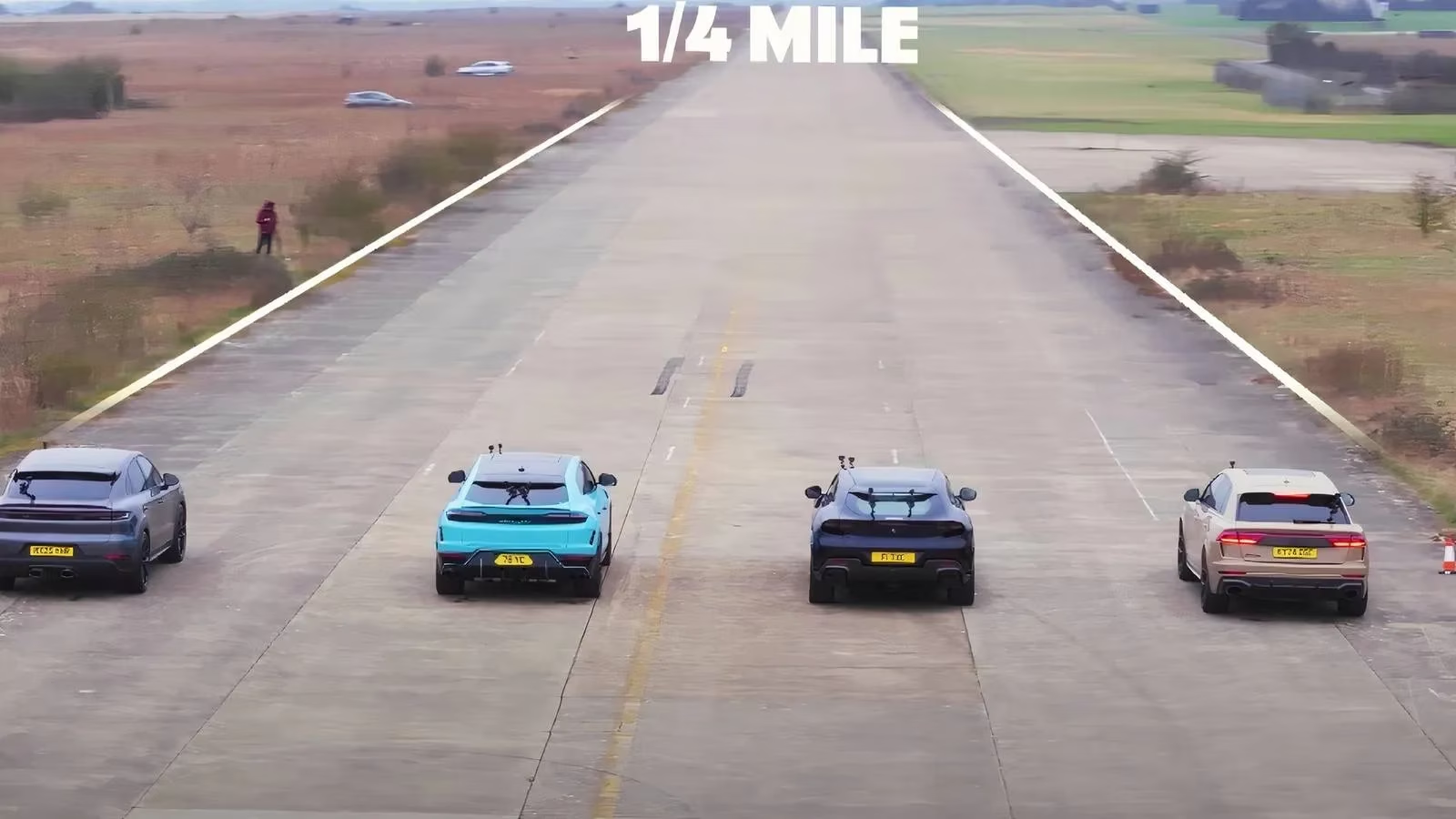
The Contenders: Luxury With a Short Fuse
The numbers alone were enough to make the morning feel ridiculous. The Porsche Cayenne Turbo E-Hybrid GT carried 739 horsepower and 700 lb-ft of torque, with a 5,498-pound body that somehow launched from 0-60 mph in just under 3.5 seconds. The Lamborghini Urus SE answered with 800 horsepower and 700 lb-ft of torque from its twin-turbo V8 hybrid setup, weighing 5,512 pounds and hitting 0-60 mph in roughly 3.5 seconds. The Ferrari Purosangue took a different path entirely, refusing hybrid assistance and relying on a naturally aspirated 6.5-liter V12 that howled to 8,250 rpm, produced 725 horsepower, and weighed a relatively lean 4,740 pounds. The Audi RSQ8 Performance rounded out the group with 640 horsepower, 627 lb-ft of torque, and the kind of razor-sharp Quattro confidence that made it feel like the quiet troublemaker in a room full of loudmouths.
| SUV | Power | Torque | Weight | 0-60 mph |
|---|---|---|---|---|
| Porsche Cayenne Turbo E-Hybrid GT | 739 hp | 700 lb-ft | 5,498 lb | Just under 3.5 s |
| Lamborghini Urus SE | 800 hp | 700 lb-ft | 5,512 lb | About 3.5 s |
| Ferrari Purosangue | 725 hp | V12 fury | 4,740 lb | Quick, dramatic, loud |
| Audi RSQ8 Performance | 640 hp | 627 lb-ft | Not quoted | Savage off the line |
The Launch That Would Not Cooperate
What followed was less a drag race and more a comedy of errors with launch control. The Ferrari bogged its launch, the Lamborghini driver joked that the SE badge sometimes felt more like SA, and the Porsche driver fluffed a start after looking steady enough to be trusted. The Audi, meanwhile, turned out to be surprisingly savage off the line, with its driver sarcastically claiming unmatched skill in releasing the brake better than any man alive. There were failed launches, botched starts, a gear warning, a minor existential crisis, and more jokes than actual racing. The runway became a stage for four very expensive machines and four drivers trying very hard to look composed.
Eventually, the group managed a proper quarter-mile drag race. The result was not the flashiest story, but it was the most German one: the Porsche took the win through relentless consistency rather than theatrics. The Ferrari, despite its glorious V12 howl, could not launch as reliably, and the Lamborghini and Audi were left to wonder what might have happened with a cleaner start. The Porsche did not need to shout. It simply kept doing the same thing well, run after run, while the others fought their own machinery and their own egos.
Rolling Race: Hybrid Punch vs V12 Fury
The action then shifted to a rolling race from 50 mph, and the mood changed instantly. In hybrid mode, the Audi rocketed ahead and left the others stunned, proving that its underdog reputation was not entirely deserved. But when the Ferrari switched into sport or manual mode, the Purosangue unleashed its full fury. Its naturally aspirated V12 screamed past the hybrids with surgical precision, turning the rolling race into a demonstration of old-school engine drama. The hybrids had instant torque and clever electronics, but the Ferrari had noise, revs, and a sense of occasion that made the others feel almost polite.
Brake Test and the Unwritten Rules
In the brake test, the Porsche and Lamborghini stopped almost identically, which was no surprise given their shared DNA and similar engineering philosophies. The Ferrari needed a bit more runway to come to a halt, but Matt shrugged it off with the kind of logic that only makes sense in a performance SUV showdown: it was a brake test, and who really cares? The Ferrari was not bought for stopping distance. It was bought for the sound, the speed, and the sheer thrill of living life in the fast lane. If braking was the main event, nobody would have invited a V12 opera singer to a hybrid fight.
The Quiet Crown and the Sneaky Underdog
When the dust settled, the Porsche snuck in and quietly took the crown. It was not the loudest, the most dramatic, or the most exotic, but it was the most complete package on the day. The Lamborghini still felt like it was warming up, waiting for more laps and another chance to show its true colours. The Audi remained the sneaky underdog that left the other three wondering if they had been sucker-punched. And the Ferrari? It left the runway with its reputation intact, not because it won every contest, but because it made every contest memorable.
In 2026, the performance SUV drag race remains a beautiful absurdity: four heavy, luxurious machines built to defy physics and common sense. The Porsche proved that consistency can beat charisma. The Ferrari proved that charisma can survive a bad launch. The Lamborghini proved that potential is a dangerous thing to waste. And the Audi proved that sometimes the quietest contender is the one most likely to land the first punch. 🏁
Comments