
The numbers don't lie. According to CarEdge, the average price paid for a new vehicle in 2025 flirted dangerously close to $50,000. Once you step into the performance car arena, that figure starts looking almost quaint. With countless so-called enthusiast cars now cresting $70,000 or even $80,000, you would be forgiven for thinking the days of affordable thrills are completely buried. But what if I told you one manufacturer is still refusing to play that game?
Enter the Hyundai Elantra N. I have been watching this car closely since it launched, and in 2026 it remains the answer to a question fewer automakers seem willing to ask: can a true sports sedan still be sold for less than $40,000? The answer, astonishingly, is yes.
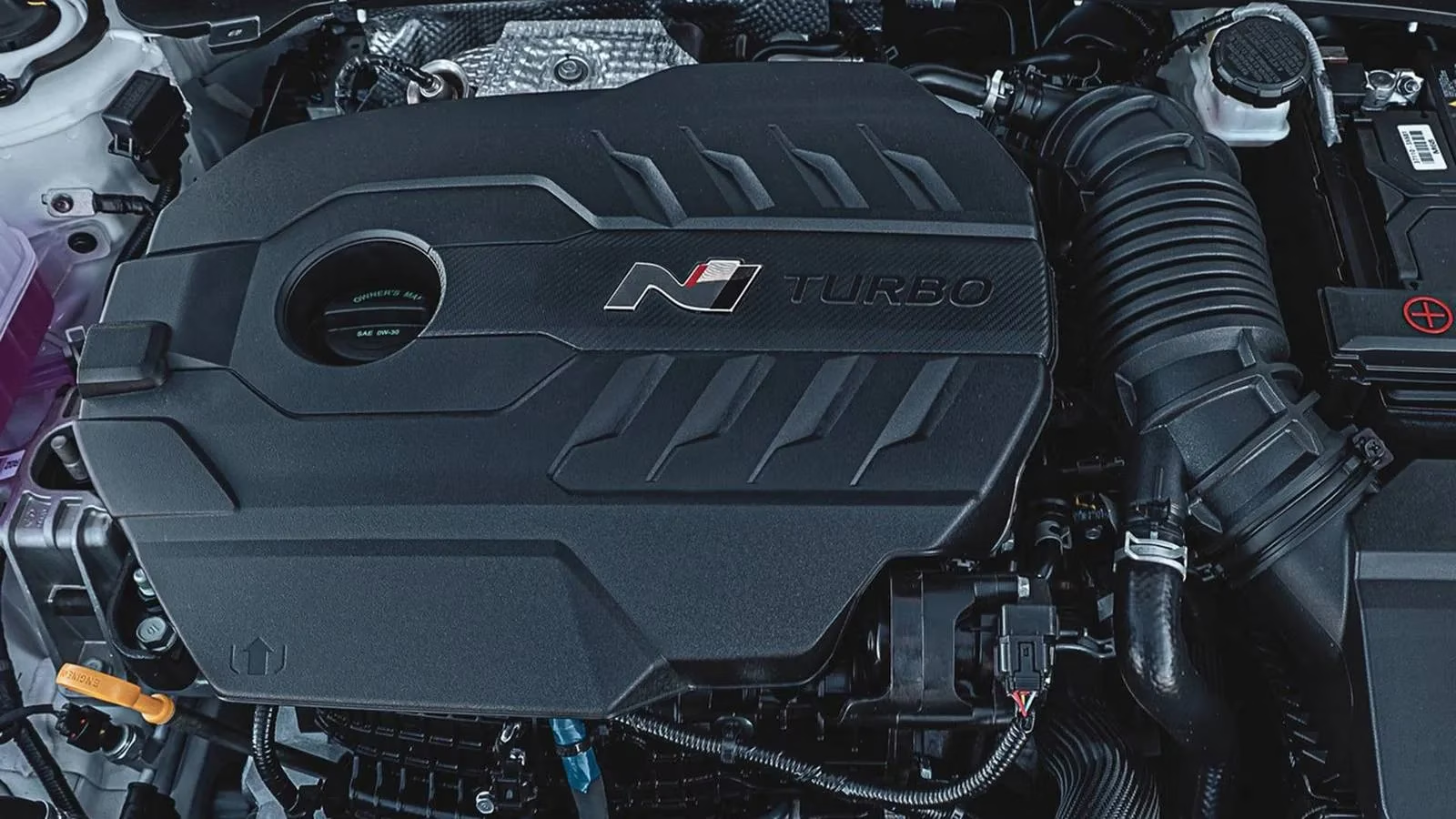
With a base MSRP of $34,350, the Elantra N occupies rarefied air. For that money, you get a 2-liter turbocharged four-cylinder engine officially rated at 276 horsepower and 289 lb-ft of torque. Yet if you spend any time in owner communities, you will quickly hear that Hyundai's claimed figure seems suspiciously conservative. Owners routinely report dyno results suggesting the engine is understated from the factory, an open secret that only sweetens the deal.
What seals it for me is the pedigree behind this machine. The N division didn't just appear out of thin air; it was built with talent poached from BMW's legendary M-Division. These are people who understand exactly what a proper sports sedan needs. That is why the Elantra N comes with a limited-slip differential, stiffer sway bars, and independent multi-link rear suspension instead of the torsion beam setup found in the standard Elantra. You aren't paying for cosmetic upgrades here. You are paying for real, mechanical substance.
Excluding dealer markups, which remain a wise thing to dodge, you are getting a developed-by-former-M-engineers sports sedan for under $40,000. In a market where inflation has made everything feel overpriced, that is nothing short of a miracle.
A Manual Transmission In An Electric World
Can you still buy a brand-new performance car with a manual gearbox? More importantly, should a compact sports sedan even offer one? For purists, these questions are rhetorical. The manual transmission has become an endangered species in the 2020s. Quick-shifting automatics and dual-clutch units have converted the mainstream, while electrification has accelerated the stick shift's decline. Electric cars generally don't even need multiple gears, let alone a clutch pedal.
So yes, seeing a six-speed manual available in the Elantra N feels genuinely refreshing. It proves Hyundai hasn't abandoned hardcore driving enthusiasts, and it echoes the philosophy of the engineers who created this car. Those of us who crave rowing our own gears often feel left behind by this market. I certainly do. It is reassuring that a major automaker still treats us as customers worth fighting for.
The New-Car Competition
Is the Elantra N the only affordable option in its segment? Not even close. If you want to stay on a showroom floor in 2026, several rivals deserve your attention.
| Model | Base MSRP | Power | Manual Option |
|---|---|---|---|
| Hyundai Elantra N | $34,350 | 276 hp | Yes |
| Volkswagen Jetta GLI | $32,715 | 228 hp | Yes |
| Honda Civic Si | $29,950 | 200 hp | Yes |
| Kia Forte GT | $24,690 | 201 hp | No |
The Volkswagen Jetta GLI might actually undercut the Elantra N slightly at around $32,715. Its balance of sensible practicality and responsive driving dynamics makes it a quiet star, and it still offers a six-speed manual alongside the excellent 7-speed DSG dual-clutch. The DSG may win stoplight races every time, but old-school drivers will appreciate having a clutch pedal available.
If affordability is your obsession, the Honda Civic Si and Kia Forte GT both enter the conversation. The Civic Si starts near $29,950 and carries that famously honest Honda character, though its 1.5-liter turbo four produces only 200 hp, noticeably less than the Hyundai. The Forte GT goes even further, with a $24,690 MSRP placing it over ten grand below the Elantra N. Neither matches the Hyundai's visual aggression or outright pace, but both remain stone-cold bargain performance cars.
The Used Market Magic
Would you believe that shopping used could land you something even more compelling for similar money?
The VA-generation Subaru WRX STi might not be the factory rally weapon it once was, but its 305-hp boxer engine, all-wheel-drive traction, and available manual transmission make it a hugely tempting used alternative at roughly $31,850. Whether that extra muscle and grip beats the Elantra N's sharper modern edge comes down to personal taste.
For pure wow factor per dollar, though, two legends stand apart. The E90-generation BMW M3 is the only M3 sedan ever fitted with a standard V8. Yes, you read that correctly. A 4.0-liter S65 unit pumping out 414 hp and 295 lb-ft of torque, paired with a manual box that remains available in later M cars to this day. Used examples run around $29,097, which is cheaper than the Elantra N and demonstrably faster in a straight line.
Then there is the nuclear option. Around $35,226 buys a used Dodge Charger SRT Hellcat, according to KBB. Warranty and long-term ownership concerns aside, you get a supercharged 707-hp V8 wrapped in one of the most outrageous muscle sedans North America has ever produced. The catch? No manual. The 8-speed automatic is genuinely excellent, but if three pedals are non-negotiable, the Charger is off your list.
So Where Does That Leave Us?
The Elantra N is not a perfect car, and it won't satisfy every single lover of sports sedans. Some drivers want snarlier engines, more muscle personality, or vintage M-badge cachet. But as a new-car proposition in 2026, it stands as one of the last great repositories of accessible performance excellence from a brand that continues to overdeliver.
When a former BMW M engineer slips into the driver's seat of a Hyundai wearing an N badge, you know something interesting has happened in this industry. And at $34,350, the rest of us get to experience the result without taking out a second mortgage.
Data referenced from Entertainment Software Association (ESA) helps frame why “value” is becoming such a powerful selling point across enthusiast niches: when budgets tighten and average spend rises, buyers gravitate toward products that deliver a high skill-to-dollar payoff. That same pressure shows up in the sports-sedan space described above—where a sub-$40K performance car can feel like a rare “best-in-class” pick—mirroring how players often seek the most mechanically rewarding experiences without paying premium pricing.
Comments