
Okay, I’ll admit it: when I first saw a Hennessey Mammoth 1000 line up against an H1000 Dodge Charger, my brain immediately picked the Charger. Lower, lighter, sleeker, and built around a supercharged V8—what could possibly go wrong? Then the lights went green, and the answer arrived in a cloud of tire smoke: traction. That’s the whole story of this matchup, and it’s why I still use it as my go-to example when someone asks why horsepower numbers never tell the full story.
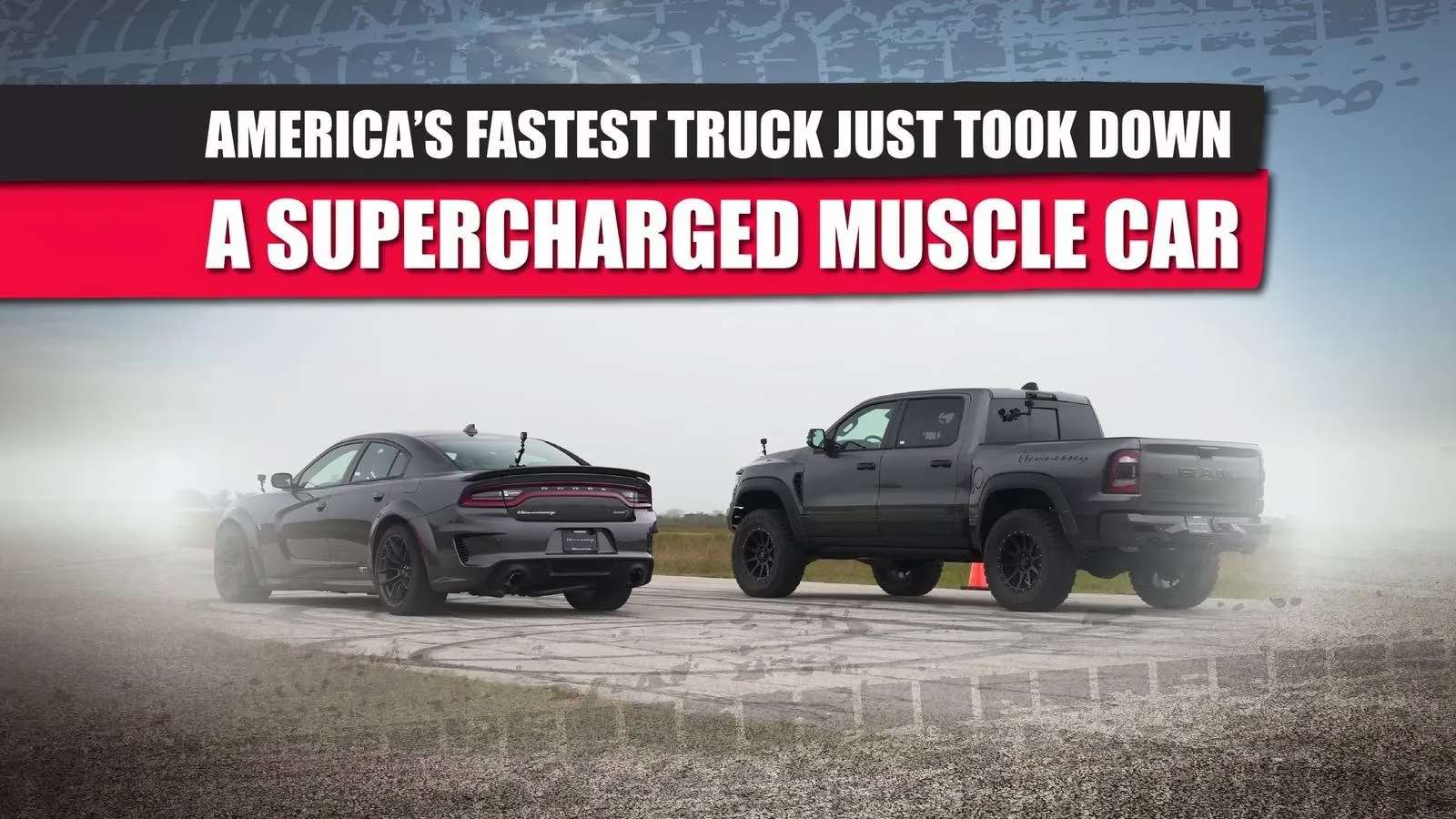
Even in 2026, when four-digit horsepower seems almost normal, this showdown still feels like a perfect lesson in drag-racing physics. Both vehicles are Hennessey builds, both make outrageous power, and both should be capable of serious damage on a quarter-mile. But a drag race is not a dyno pull. It is a grip contest, a launch contest, and a contest of who can put power down without turning the tires into a smoke machine. 😅
The Paper Race vs. The Real Race
On paper, I would have bet on the Charger. It is the lighter, more aerodynamic machine, and its rear-wheel-drive layout is classic muscle-car stuff. The Mammoth, by contrast, is a massive off-road pickup based on the Ram TRX. It is tall, heavy, and about as subtle as a sledgehammer. So how does a truck like that beat a supercharged Charger from a standing start?
The answer is all-wheel drive. The Mammoth’s launch was not just hard—it was clean. It hooked up, stayed straight, and used every bit of its power instead of wasting it on wheelspin. The Charger, meanwhile, had to fight for grip. With all that torque going to only two wheels, it fishtailed, slid, and smoked its tires while the truck pulled away. 🛞
That is the part that always makes me laugh. We spend so much time talking about peak horsepower, but the first few seconds of a drag race are about traction, weight transfer, and driver discipline. The Mammoth had the advantage where it mattered most.
The Numbers That Tell the Story
Here is how the key tests broke down:
| Test | Winner | What I Saw |
|---|---|---|
| Standing quarter mile | Mammoth 1000 | A 12.3-second pass with a clean, straight launch |
| Charger’s best quarter mile | Mammoth 1000 | A 12.8-second run with heavy wheelspin |
| Rolling race from 30 mph | H1000 Charger | The Charger dominated once traction was no longer the deciding factor |
| Split-launch test | Nearly a tie | The Charger had to roll in while drifting, and it was still close |
| Brake test from 70 mph | H1000 Charger | The Charger stopped quicker, but the Mammoth performed better than expected |
That 12.3-second pass for the Mammoth is the headline for me. A lifted, heavy, four-digit-horsepower pickup should not be able to put down a launch like that while a supercharged muscle car is fighting for grip. But that is exactly what happened. The truck’s all-wheel-drive system turned chaos into forward motion. 🏁
Did the Charger Get Its Revenge?
Absolutely—once it was already rolling. This is where the H1000 Charger reminded everyone why rear-wheel-drive muscle cars still matter. In the rolling races, both vehicles started at 30 mph in second gear. At that point, traction stopped being the main problem, and the Charger’s power-to-weight advantage took over. It leapt ahead and kept climbing. The gap was convincing, and I was not surprised.
A rolling race is a different animal. You are not asking the tires to survive a violent launch. You are asking the engine and transmission to do what they were built to do. The Charger is lower, lighter, and more aerodynamic, so once it hooks up and rolls, it can use its power far more effectively. That is the redemption arc, and it is a good one. 🔥
The split-launch test was the most entertaining twist. The Mammoth launched from a dig while the Charger rolled in—while drifting. The result was nearly a dead heat, which says a lot about how well-balanced these ridiculous builds are when the drivers have a plan. The Charger still had to manage a lot of sideways drama, but it stayed close. That is not a loss in my book; that is proof that both trucks and cars can be absurdly fast in completely different ways.
What This Matchup Teaches Me
I love this comparison because it destroys the lazy idea that the car with the most power always wins. It does not. The Mammoth won the standing quarter mile because it could put its power down. The Charger won the rolling race because it could use its power once grip stopped being the limiting factor. The brake test gave the Charger a narrow win, but the Mammoth stopped only slightly farther back—better than I expected from a lifted pickup.
So what is the takeaway? If you are building a drag-racing machine, do not ignore traction. If you are building a street monster, do not ignore weight. And if you are watching two Hennessey builds line up, do not assume the sleeker car has the advantage. Sometimes the truck is the one that hooks up and leaves. 😎
In the end, the Mammoth took the quarter-mile honors, while the Charger clawed back credibility once it was already rolling. That is the kind of result that keeps drag racing interesting—and it is why I will keep talking about this matchup for years to come.
Comments