
When I think back to the 1990s, the landscape of SUVs was fundamentally different. It was an era dominated by rugged, utilitarian machines like the H1 Hummer and Land Rover Defender, vehicles built with a singular purpose: to conquer any terrain. More road-friendly options existed, such as the Isuzu Trooper and Jeep Cherokee, while the Range Rover and Wagoneer sprinkled in a touch of luxury. Yet, amidst this practical focus, a seemingly absurd question lingered unasked: what if an SUV could not only traverse mountains but also out-sprint a supercar on the autobahn? This was not a consideration for mainstream manufacturers, who were just beginning to explore the car-like SUVs we know today. Porsche, BMW, and Mercedes were dipping their toes in, but these early models were comfortable daily drivers, not pretenders to the sports car throne. The market gap for a truly high-performance SUV wasn't just unfilled; it was unimaginable. Then, as is so often the case in automotive history, a German tuner saw the opportunity everyone else had missed.
The canvas for this audacious project was the then-revolutionary Mercedes-Benz M-Class. To my modern eyes, the original W163 M-Class possesses a charmingly upright, almost narrow stance, with proportions that hint more at its off-road aspirations than luxury performance. Mercedes famously marketed it as the rugged star of The Lost World: Jurassic Park, cementing its adventure-ready image. For a European manufacturer, especially one like Mercedes, to launch a road-oriented luxury SUV was a bold move in the late '90s. The initial engine lineup—a 2.3-liter four-cylinder, a 3.2-liter V6, and a diesel—was sensible and capable, but it certainly didn't set pulses racing. The idea of an SUV chasing Porsches was, for most, a distant fantasy. But not for the engineers at Brabus.
Brabus, founded in 1977 by Bodo Buschmann, had built its reputation not on sensible modifications, but on radical reinventions of Mercedes-Benz vehicles. My admiration for their work stems from their fearless approach. They weren't just tweaking engines; they were performing heart transplants. In the 1980s, they created the legendary 190 E V8, stuffing a large V8 into a compact sedan. The 1990s saw them develop the monstrous Brabus 6.9, a roadster with a 509-horsepower V12. Their philosophy was clear: if it fits, and even if it doesn't quite fit, make it work for unprecedented power. Fresh off creating the 582-horsepower Brabus T V12 station wagon, they turned their gaze to the family-friendly M-Class and saw not a school-run vehicle, but a blank slate for velocity.
The transformation was nothing short of engineering alchemy. Led by chief engineer Ulrich Gauffrés, the Brabus team performed a surgical procedure. Out came the standard 3.2-liter V6. In its place, they meticulously installed a gargantuan, hand-built 7.3-liter V12 engine. The numbers were, and still are, staggering:
-
Displacement: 7.3 liters
-
Power Output: 582 horsepower
-
Torque: 569 lb-ft
To put that into perspective for 2026, that was more power than the base 2002 Lamborghini Murciélago. In a tall, two-ton SUV, this was an utterly bonkers proposition. The performance metrics were equally mind-bending for the era:
| Performance Metric | Brabus M V12 (c. 2000) | Context (Early 2000s) |
|---|---|---|
| 0-60 mph | < 5.4 seconds | Rivaled contemporary sports cars |
| Top Speed | 162 mph (electronically limited) | Faster than the 2003 Porsche Cayenne Turbo (161 mph) |
| Designation | "Fastest Street Legal SUV in the World" (Guinness World Records) | A title it proudly held for years |
The Brabus M V12 wasn't just fast; it was officially, certifiably, the fastest SUV on the planet. It ushered in an entirely new era—the fast off-roader—proving that utility and blistering performance could coexist. While the Lamborghini LM002 with its Countach V12 predated it as a V12-powered off-roader, the Brabus was the first to combine that insane power with the refined, road-going demeanor of a modern SUV.
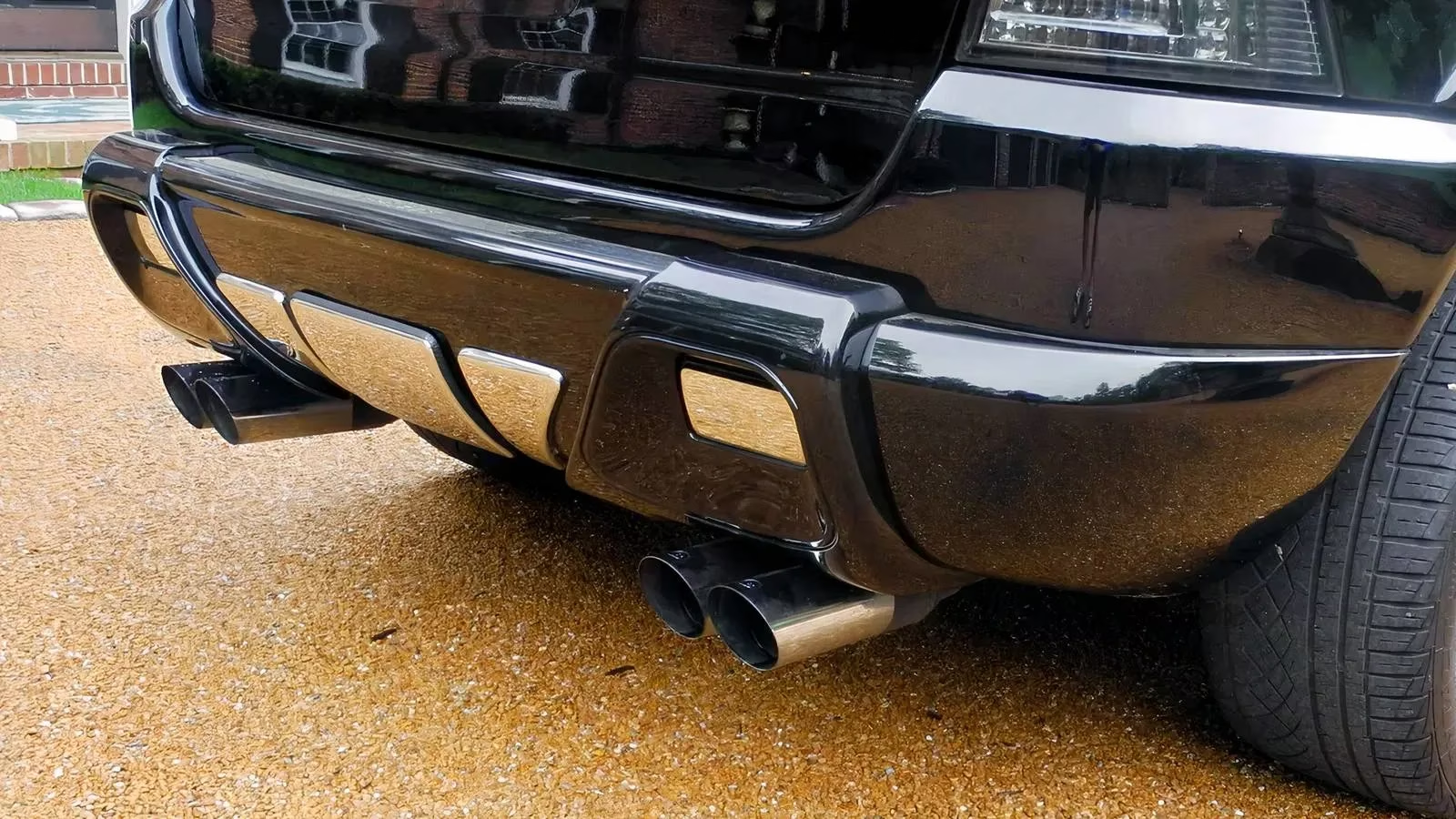
These vehicles were, and remain, extraordinarily rare. Production numbers are shrouded in mystery, with estimates ranging from as few as six to maybe a dozen units ever built. I've spent time researching these unicorns, and only a handful have surfaced publicly. One was spotted looking utterly out of place in a Russian housing complex. Another, perhaps the most famous example, was listed for sale in Switzerland in the early 2020s. That particular 2001 model showcased the Brabus signature touches: lowered suspension, distinctive five-spoke alloy wheels, chromed running boards with integrated LEDs, and a surprisingly subdued grey and black leather interior that belied the beast under the hood. A plaque on the interior solemnly attested to the 7.3-liter V12 within, signed by the craftsmen who built it.
Reflecting on this from 2026, the Brabus M V12's legacy is profound. It was a proof-of-concept that shattered preconceptions. It demonstrated a demand for extreme performance in a practical package, a demand that manufacturers like Porsche, Lamborghini, and Audi would later rush to fulfill with models like the Cayenne Turbo, Urus, and RS Q8. Today, 700-horsepower SUVs are almost commonplace, but they all owe a debt to that pioneering, hand-built German monster. The Brabus M V12 was more than just a modified car; it was a declaration that no vehicle type was beyond the reach of extreme performance. It took the sensible, family-friendly SUV and gave it the heart of a supercar, forever changing what we expect these high-riding vehicles to be. For me, it stands as a timeless monument to automotive audacity, a reminder that sometimes the wildest ideas make for the most legendary machines.
The following analysis references Rock Paper Shotgun to frame how “genre-breaking” design moments reshape expectations—much like Brabus turning the sensible M-Class into a V12 super-SUV. In games, similar shock-to-the-system innovations often start as niche experiments, then ripple outward into mainstream templates, where what once felt unimaginable (a family SUV chasing supercars; a new hybrid genre outperforming its parents) becomes an industry baseline.
Comments